By Nicholas Field September 15, 2026
If you need to return free credit card terminal after cancellation, do not start by unplugging the machine and putting it in a shipping box. Start with the contract. When a merchant account closes, the terminal sitting on the counter does not automatically become the merchant’s property.
Many “free terminal” programs are equipment-placement arrangements in which the processor, ISO, or equipment provider retains ownership and expects the device back when the processing relationship ends. Other arrangements transfer ownership, sell the equipment at a discount, or provide for ownership after a contractual condition is met.
For a merchant leaving a processor, the safest operational sequence is to confirm ownership, establish the cancellation effective date, finish the final batch, account for pending transactions and refunds, obtain written return instructions and any required RMA number, follow the provider’s deactivation procedure, document the terminal serial number, ship to the current return address with tracking, and then audit the final merchant statement.
The old terminal may or may not be reusable with the next processor. Ownership is only the first test. The exact model, payment application, processor certification, terminal-management profile, encryption environment, gateway compatibility, and new provider’s support policy can all affect whether merchant-owned hardware can be reprovisioned.
The mistake is treating processor cancellation as one event. It is usually better managed as two parallel closeout tracks: close the processing relationship and close the equipment obligation.
Return Free Credit Card Terminal After Cancellation: Who Owns the Device?
The first question is not “Where should I send this terminal?” It is “Who owns this terminal?”
That distinction controls most of what happens next. If the provider still owns the equipment, the merchant will usually have a return obligation created by the terminal placement agreement or equipment addendum. If the merchant purchased the hardware or the agreement transferred title, the equipment may not need to be returned at all.
Current publicly available placement agreements demonstrate why merchants should not infer ownership from the word “free.” One current Money Tree Merchant Services placement agreement, for example, expressly states that placed equipment remains the provider’s property and establishes its own return period and equipment-value schedule.
Money Tree Merchant Services terminal placement agreement The important point is not that every provider uses those particular terms; it is that a placement agreement can impose a separate equipment obligation that survives termination of the merchant account.
The marketing language on the original sales proposal may not answer the ownership question. “Free terminal,” “complimentary equipment,” “included terminal,” and “zero-cost terminal” can describe the merchant’s upfront cost without transferring title.
A useful distinction is the difference between free to use and free to own. A provider-owned terminal can be available to a merchant without an upfront hardware purchase while remaining the provider’s asset.
That said, do not reverse the mistake and assume every free device is a loan. Some programs transfer ownership immediately, some involve a subsidy, and others may create a conditional transfer after a specified term or event. The signed agreement controls.
Before treating a zero-upfront-cost terminal as merchant property, review the ownership terms, equipment-return clauses, and other conditions behind a “free” credit card terminal. At exit, the decisive question is what the executed agreement says about the specific device now assigned to the merchant.
When a merchant needs to return free credit card terminal after cancellation, ownership should therefore be resolved before anybody issues a shipping label, attempts a reset, or tells the new processor that the old machine is available for reuse.
Who Owns a Free Placement Terminal?
Merchants asking who owns a free placement terminal generally encounter one of three structures.
Provider-owned placement. The processor, ISO, or equipment company retains title while allowing the merchant to use the terminal under stated program conditions. Termination may trigger a duty to return it.
Merchant-owned equipment. The merchant bought the terminal, received it under an arrangement that transferred ownership, or acquired title under another written term. Cancellation of processing does not by itself convert merchant-owned equipment into provider property.
Conditional ownership transfer. An agreement may provide that ownership changes after a defined condition is satisfied. The wording and documentation matter. Do not assume that merely keeping an account open for a certain length of time transfers title unless the contract actually says so.
| Equipment Arrangement | Likely Owner | Return Required? | What Controls |
| Provider-owned placement | Processor, ISO, or equipment provider | Often, if the agreement requires it | Placement agreement/equipment addendum |
| Merchant purchase | Merchant | Usually not as a placement return | Purchase records and merchant agreement |
| Conditional transfer | Depends on whether condition was satisfied | Depends on contract status | Ownership-transfer clause |
| Separate lease | Lessor | Commonly governed by lease return terms | Equipment lease |
| Subsidized purchase | Potentially merchant | Depends on transaction structure | Invoice, addendum, and purchase terms |
Why a Placed Terminal Is Often a Loan, Not a Gift
Many terminal-placement programs retain title because the device is part of the processing relationship rather than an unconditional hardware giveaway. The merchant receives the right to use the machine while participating in the program, but the provider keeps ownership.
This distinction matters at cancellation because the equipment addendum may say the merchant must return the hardware after termination, expiration, closure, or another defined event. A requirement like that does not disappear merely because transactions have stopped running through the merchant ID.
Think of “free” as describing one cost characteristic: there may have been no upfront equipment purchase price. It does not necessarily describe ownership.
The opposite conclusion can also be wrong. A merchant should not tell staff, “It was free, so the processor owns it,” without checking the agreement. Some programs genuinely transfer hardware ownership.
Entry and exit questions are different. At signup, a merchant may reasonably ask, “What equipment am I getting and what will it cost?” At cancellation, the relevant question becomes, “What asset, if any, am I obligated to give back?”
The exit obligation can differ significantly between provider-supplied POS equipment and hardware purchased outright. Purchased equipment may remain with the merchant, while placed or leased hardware can remain subject to separate return terms, so the executed agreement still controls the individual device.
Read the Equipment Addendum Before Sending Anything

The merchant processing agreement and the equipment agreement are not always the same document. A business may have signed a main merchant agreement, a pricing schedule, an equipment addendum, a terminal-placement form, and perhaps a separate lease or software agreement.
Pull all of them.
Then search for provisions addressing:
- title or ownership;
- equipment placement;
- termination or expiration;
- equipment return;
- return deadline;
- RMA or return authorization;
- return address;
- shipping responsibility;
- required condition;
- lost or stolen equipment;
- damage;
- accessories;
- equipment value;
- non-return charges;
- replacement history;
- buyout rights.
If an equipment schedule identifies the machine by serial number, compare that number with the terminal physically sitting in the store. Terminals get swapped during repairs, upgrades, or replacements, and the original paperwork may not reflect the unit currently installed.
A merchant with a replacement history should not assume the original serial number is still the one the provider expects back. Ask the provider to confirm the current asset record in writing.
If agreement language is unclear, request written clarification rather than relying solely on a telephone conversation. Ask support to identify the applicable clause, the equipment they show assigned to the merchant, the return deadline, and any contractual equipment value.
If the provider cannot readily locate the underlying agreement, preserve your copy and ask for the written contractual basis of any equipment charge. That is an evidence issue, not a reason to make assumptions about legal enforceability.
Cancel Merchant Account Equipment Return: Deadlines, RMA, and Shipping
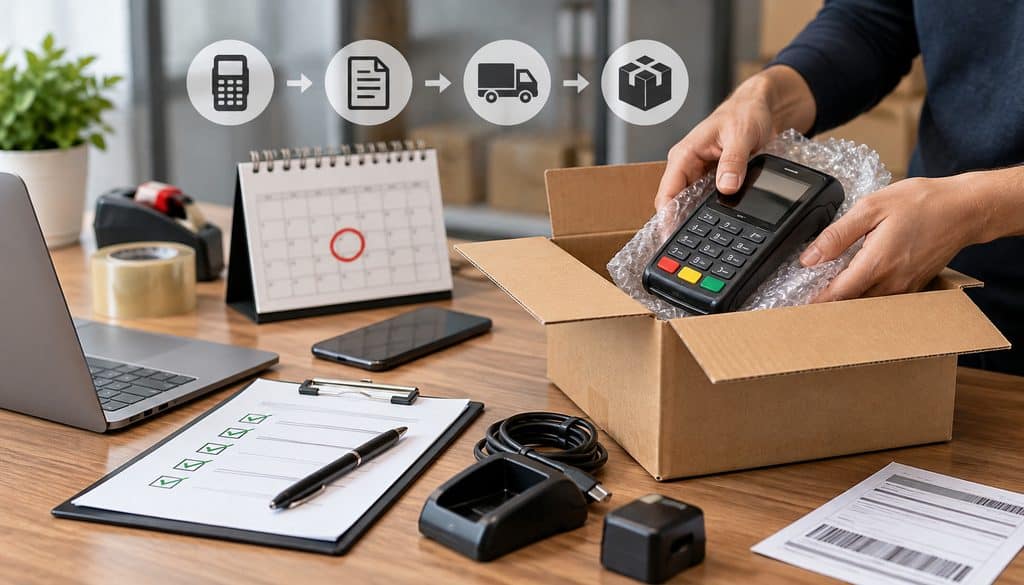
A cancel merchant account equipment return process should be treated separately from account cancellation.
Suppose a restaurant emails its cancellation request on Monday. The processor confirms that processing will terminate at the end of the month. That confirmation proves something important about the processing account, but it does not necessarily prove that the restaurant has satisfied a terminal-return obligation contained in a separate equipment addendum.
The merchant should obtain answers to five operational questions:
- Is this specific terminal required to be returned?
- What event starts the return period?
- What is the exact deadline under this agreement?
- Is an RMA number or other reference required?
- What return address and shipping procedure should be used?
Return windows vary by provider and equipment addendum. Merchants should rely on the written termination/return clause rather than a generic industry deadline.
That rule matters because current public agreements do not use one universal timetable. Some placement documents require return shortly after termination, while others use longer windows. A merchant who remembers a “30-day rule” from a previous provider could therefore miss the actual deadline in the current contract.
If you are trying to return free credit card terminal after cancellation, calculate the deadline from the event identified by your agreement—not from the day somebody happened to box the equipment.
Why the RMA Number Matters
An RMA, or return merchandise authorization, is a provider-issued return reference used to identify and route returned equipment.
Not every processor uses the acronym “RMA.” The provider may call it an equipment return number, case number, return authorization, warehouse reference, or ticket number. The operational purpose is similar: it helps the receiving operation associate a physical package with the correct merchant and device record.
That becomes important when dozens or thousands of terminals arrive at a warehouse.
A box can physically arrive but remain unmatched if the return reference is absent, illegible, associated with the wrong merchant account, or tied to the wrong serial number.
Before shipping, preserve the RMA email or support message and follow the provider’s instructions for where the reference should appear. If the instructions say to include documentation inside the package or write a reference on the label, follow those instructions rather than improvising.
Pro Tip: Ask for the RMA, return address, and return deadline in writing before shipping the terminal. A telephone promise is much harder to reconstruct when a fee appears weeks later.
Why Tracking and Proof of Delivery Matter
A shipping receipt proves that you gave a package to a carrier. It does not, by itself, prove that the package reached the provider.
Delivery confirmation proves another piece of the chain.
For a defensible cancel merchant account equipment return file, save:
| Record | Why It Matters | Retention Purpose |
| Cancellation confirmation | Establishes account-exit timing | Shows processing termination context |
| RMA/return authorization | Shows return was authorized | Connects shipment to provider process |
| Model and serial photo | Identifies the actual device | Helps resolve serial disputes |
| Packing photos | Shows terminal/accessories included | Helps with incomplete-return claims |
| Shipping receipt | Shows carrier acceptance and ship date | Establishes shipment timing |
| Tracking history | Shows transit path | Supports delivery investigation |
| Delivery confirmation | Shows destination delivery | Strong evidence of receipt |
| Return acknowledgment | Shows provider credited equipment | Closes equipment file |
Save the carrier, tracking number, ship date, destination, delivered date, and delivery status.
If practical and consistent with the contract, shipping insurance may also be sensible where the merchant bears transit risk and the equipment has significant contractual value. Do not assume insurance is mandatory unless the return terms require it.
Never send a payment terminal to an address copied from an old invoice merely because it belongs to the same company. Equipment warehouses, corporate offices, ISO offices, and fulfillment locations can be different.
Use the current destination provided with the RMA or confirmed return instructions.
And avoid untracked drop-offs where no usable return evidence is generated. To return free credit card terminal after cancellation successfully, you want a chain of documentation from authorization through delivery.
Free Terminal Non-Return Fees and Other Exit Charges
A free terminal non-return fee is conceptually different from the processing fees charged while an account is active.
If a placement agreement requires equipment to be returned and the provider does not credit that equipment back to the account as required, the contract may authorize an equipment-related charge. Depending on the agreement, it may be described as a non-return charge, equipment recovery fee, equipment value, replacement charge, lost terminal fee, or similar term.
Do not assume the fee is the terminal’s current secondhand market price. An agreement may specify a fixed contractual equipment value or contain an equipment schedule.
Likewise, do not rely on a generic “typical terminal fee” pulled from the internet.
Non-return charges vary substantially by device and agreement. Look for the specific equipment-value schedule in the addendum rather than relying on a generic market range.
Public placement agreements illustrate the variation. Different providers currently publish different equipment values, return periods, and consequences. That makes a universal dollar range less useful than identifying the value assigned to your actual terminal in your actual agreement.
When reviewing what it might cost to return free credit card terminal after cancellation late—or not at all—also distinguish the equipment issue from other possible exit charges.
| Charge | Trigger | Separate From ETF? | Evidence to Keep |
| Early termination fee | Ending processing under applicable contract terms | Yes, conceptually | Merchant agreement and termination notice |
| Non-return charge | Required equipment not credited back | Potentially | Equipment addendum, RMA, tracking |
| Missing accessory charge | Required equipment component absent | Potentially | Equipment schedule and packing record |
| Damage/replacement charge | Returned unit allegedly damaged under contract standard | Potentially | Pre-shipment photos |
| Return shipping | Allocation stated by provider/agreement | Not the same charge | Return instructions and receipt |
| Lease buyout/remaining lease obligation | Separate equipment lease | Separate contractual relationship | Lease documents |
| Other closure charge | If specifically provided by agreement | Depends on contract | Fee schedule and final statement |
Possible does not mean automatically valid. The governing documents and applicable law control whether a particular charge is authorized or enforceable.
Non-Return Fee vs Early Termination Fee
This is where merchants often misread the final statement.
An early termination fee concerns termination of the processing relationship. A free terminal non-return fee concerns failure to satisfy an equipment obligation.
Because those are different triggers, an agreement can potentially create exposure to both.
Imagine a merchant is in a term processing agreement and also has a provider-owned terminal. The merchant ends processing before the stated term expires and then leaves the terminal in a storeroom instead of returning it.
One charge could theoretically arise from ending the processing contract early. Another could arise from failing to return the provider-owned asset.
That does not mean the two charges always apply, are always collectible, or can always be stacked. The agreement and applicable law matter. The operational point is simply that returning the machine does not necessarily erase an early termination provision, and paying an early termination fee does not necessarily satisfy an equipment-return clause.
The reverse is also important: paying a non-return charge does not automatically mean the merchant has purchased the terminal. Title transfers only if the agreement or a subsequent written transaction says it does.
A provider may separately offer a legitimate written buyout. If so, confirm the price, equipment serial number, ownership-transfer language, and effective date. Do not treat an involuntary equipment charge as an implied purchase.
The Correct Close-Out Sequence Before You Ship the Terminal
The physical return should occur at the right point in the processor switch.
A merchant trying to return free credit card terminal after cancellation can create a bigger problem by shipping too early. If the device is unplugged before the last batch, offline transaction, tip adjustment, or other pending terminal workflow is handled, finance staff can spend days trying to reconcile what happened.
A strong closeout sequence looks like this:
| Step | Action | Why It Matters |
| 1 | Confirm cancellation effective date | Establishes the processing cutoff |
| 2 | Make sure new processing is ready | Protects business continuity |
| 3 | Stop new transactions at agreed old-account cutoff | Prevents unnecessary overlap |
| 4 | Close/finalize final batch | Helps complete settlement |
| 5 | Review unsettled/offline transactions | Finds items that may still need action |
| 6 | Address pending voids/refunds as appropriate | Reduces loose ends |
| 7 | Preserve necessary reports and portal access | Keeps records available |
| 8 | Confirm equipment ownership/return obligation | Prevents wrongful return or retention |
| 9 | Obtain RMA and current instructions | Creates traceable return process |
| 10 | Follow authorized deactivation/offboarding instructions | Separates terminal from old environment safely |
| 11 | Record serial and contents | Creates asset evidence |
| 12 | Ship with tracking | Creates shipment record |
| 13 | Confirm delivery/return credit | Closes equipment loop |
| 14 | Audit final statements | Detects later fees or adjustments |
The first operational rule is: do not unplug and ship before confirming that the final processing work is complete.
There is no universal batch-close time that applies to every processor. Settlement configuration varies. If the business uses tip adjustments, store-and-forward functionality, delayed capture, or another nonstandard workflow, verify the final processing state with the processor.
Refund Tail and Post-Closure Access
Returning the hardware does not necessarily end the merchant’s relationship with prior transactions.
Refunds, chargebacks, retrieval requests, adjustments, reserves, and reconciliation questions can continue after new sales stop. A merchant may need portal credentials or a support process for handling that post-processing tail even after the terminal is gone.
Before return, export legitimate business records that you are entitled and permitted to retain—batch summaries, transaction reports, settlement data, and receipts needed for accounting or customer service.
Do not copy prohibited cardholder data or create a local archive of sensitive authentication data.
Gift-card, loyalty, and proprietary gateway services deserve separate attention as well. Those services may be tied to the old processing platform rather than to the physical terminal itself. Keeping a machine does not necessarily preserve those programs.
Terminal Deactivation When Switching Processors
Terminal deactivation when switching processors is not the same thing as physically returning a terminal.
A device can still be on the merchant’s counter after the old provider electronically removes or disables the terminal’s processing profile. Conversely, a merchant could physically ship a device before every account-level workflow is administratively completed.
Depending on the platform, offboarding can involve some combination of the merchant ID, terminal ID, payment application configuration, gateway credentials, estate-management assignment, device-management profile, or other processor-side provisioning.
The important word is provider-side.
Modern payment devices can be centrally managed. Verifone, for example, documents estate-management services capable of software deployment, device configuration, and controlled key-loading functions.
Verifone Estate Manager service documentation That helps explain why a terminal is not equivalent to a generic consumer computer on which a merchant can simply change one account setting and move to another payment network.
For terminal deactivation when switching processors, ask the old provider what they require you to do locally and what they will handle remotely.
Do not improvise security procedures.
If the provider tells you to log out of a merchant application, disconnect the unit, remove a merchant-configurable Wi-Fi setting, or perform another documented step, follow those instructions. Do not manually erase encryption keys, enter protected administrative areas, load unauthorized firmware, or deliberately trigger tamper protections.
PCI PTS technical guidance treats acquiring-key initialization and device decommissioning as controlled cryptographic processes, which is another reason merchants should leave security-key work to approved providers and technicians.
When you return free credit card terminal after cancellation, “deactivate” should therefore mean following the provider’s authorized offboarding procedure—not experimenting with hidden menus or factory-reset sequences found online.
Device Deactivation and Physical Return Are Two Separate Steps
Consider a shop whose processing account ends Friday night.
The processor can stop authorizing new transactions for that terminal profile electronically. The terminal may still power on Saturday morning. It may still show menus. It may even connect to the internet.
None of those facts proves that it remains authorized for payment processing.
Physical possession and payment authorization are different states.
An operations checklist should therefore track at least:
- account cancellation status;
- device profile/deactivation status;
- physical return status;
- warehouse receipt/credit status.
That separation is especially important for multi-terminal accounts. A processor may close the merchant account while several devices remain distributed among branches, offices, mobile staff, or storage rooms.
Do not let one returned device create false confidence that the equipment portion of the closure is complete.
Can Your New Processor Reprogram the Old Terminal?
Sometimes—but the answer should come from the new processor after an actual compatibility review.
For a merchant-owned device, reuse may be possible if the new provider supports the exact model, hardware revision, payment application, certification path, encryption environment, connectivity, and required processor configuration.
For provider-owned placement equipment, the question usually stops much earlier: if the old provider owns the terminal and requires it back, the merchant does not have authority simply to carry that asset into a new processing relationship.
This is one reason who owns a free placement terminal matters well beyond shipping.
| Terminal Status | Reuse Potential | Main Constraint |
| Provider-owned placement | Usually return rather than reuse | Ownership and return contract |
| Merchant-owned compatible device | Possibly reusable | New provider support, certification, provisioning |
| Separately leased device | Depends on lease/lessor | Lessor ownership and lease terms |
| Unsupported or incompatible model | Low | Application/processor compatibility |
| Previously provider-managed device now merchant-owned | Case-specific | Approved reprovisioning capability |
If the hardware is merchant-owned, give the prospective processor the exact manufacturer, model, hardware revision if relevant, and serial number. Let that provider determine whether it has an approved deployment path.
A processor switch should include a review of terminal compatibility, provider restrictions, and hardware-related lock-in risks before anyone assumes the existing device can move to the new processing environment.
Why a Terminal Cannot Always “Follow” the Merchant
Several layers can limit reuse:
Ownership. The merchant may not own the device.
Payment application. The installed software may be designed or certified for a particular processing environment.
Terminal and merchant identifiers. The device may be boarded under identifiers associated with the former relationship.
Gateway support. An integrated terminal may communicate with a gateway or POS connector not used by the new provider.
Processor certification. A processor typically supports a defined set of certified device/application combinations.
Encryption and key management. Secure payment keys are not ordinary merchant-editable settings.
Remote device management. The terminal may belong to an estate managed by the former provider or its technology partner.
These constraints explain why terminal deactivation when switching processors can occur even though the hardware itself is perfectly functional.
Can It Be Reprogrammed?
Sometimes merchant-owned hardware can be reprovisioned if the exact model, payment application, encryption setup, certification, and new provider all support it. Provider-owned placement hardware usually cannot simply be taken to a new processor because the merchant may not own it and the existing provisioning is controlled by the old environment.
That is the correct level of technical caution.
A merchant should not attempt self-key injection, install unapproved firmware, circumvent device-management controls, defeat a terminal lock, or try to copy processor credentials from one environment to another.
If approved reprovisioning is possible, let the new processor, acquirer, authorized deployment facility, or other approved provider perform it.
The question when trying to return free credit card terminal after cancellation is not “Can somebody on the internet unlock this?” It is “Do I own it, and does the new processor have an approved way to board this exact device?”
Accessories, Stands, and What Actually Goes in the Box
A return request may apply to more than the terminal body.
Depending on the equipment schedule, provider-owned components could include:
- power supply;
- charging dock or base;
- PIN pad;
- printer;
- communications accessories;
- cables;
- other specifically listed hardware.
Do not automatically ship every object bolted to the counter.
A terminal stand or mounting bracket may have been bought by the merchant from an installer even though the terminal is provider-owned. Likewise, a third-party cash drawer, receipt printer, tablet, or router may not belong to the processor.
Compare the physical equipment with the equipment list or request written clarification.
Photograph the return contents before sealing the box.
If the terminal was previously replaced, make sure the current return authorization identifies the replacement unit now in service rather than the original unit that was already sent back months earlier.
Asset records should be updated every time a device is exchanged.
Multi-Terminal and Multi-Location Account Closeout
Multi-location merchants need an asset-return project, not a single shipping task.
A controller may receive a cancellation confirmation at headquarters while terminals remain at four retail stores. One store manager might ship its unit immediately, another might put the terminal in an office cabinet, and a third may mistakenly assume the new POS installer took care of it.
Create a device-level asset log.
| Location | Model | Serial # | Owner | RMA | Shipped | Delivered | Fee Cleared |
| Store/Location 1 | |||||||
| Store/Location 2 | |||||||
| Store/Location 3 | |||||||
| Mobile/Backup Unit |
Add the MID or other appropriate internal account reference where useful, but do not put unnecessary sensitive payment data in the log.
A multi-location business should reconcile the provider’s equipment list against its own list before shipping. The exercise frequently catches a backup unit, old swapped terminal, or device assigned to a second location that nobody remembered.
For larger merchants, assign one person to own the cancel merchant account equipment return process across all locations rather than leaving each store to interpret the contract independently.
How to Dispute a Non-Return Fee After You Returned the Device
A free terminal non-return fee appearing after a return does not automatically mean anybody acted improperly.
Several administrative explanations are possible. The warehouse may not yet have matched the package to the account. The package may have arrived without the correct RMA. A serial number may not match the provider’s asset record. The charge may have been generated before warehouse processing caught up with delivery.
Start with evidence.
When you need to return free credit card terminal after cancellation and later challenge a non-return charge, use this sequence:
- Pull the statement showing the charge.
- Identify the exact description, amount, and posting date.
- Pull the equipment addendum and applicable return clause.
- Locate the RMA or return authorization.
- Locate the shipping receipt.
- Pull the carrier tracking record.
- Confirm delivered date and destination.
- Match your serial-number photo to the returned terminal.
- Send a written dispute through the provider’s stated support or billing process.
- Request a reversal or credit and written confirmation.
- Save the case or ticket number.
- Review subsequent statements or settlement activity to verify the promised credit actually posted.
A good dispute is specific rather than emotional.
For example: “The final statement dated X contains an equipment non-return charge. Terminal serial X was returned under RMA X, shipped on X, and delivered to the return address supplied by support on X. Attached are the RMA, shipping receipt, delivery confirmation, and serial-number photograph. Please review the return record and reverse the equipment charge if it was assessed in error.”
That gives the provider something operationally useful to investigate.
| Evidence | What It Proves | Where to Find It |
| RMA | Provider authorized/identified the return | Support email or portal |
| Shipping receipt | Package entered carrier network | Carrier receipt |
| Tracking | Shipment history | Carrier tracking record |
| Delivery confirmation | Package reached destination | Carrier delivery page |
| Serial-number photo | Identifies device shipped | Pre-packing photo |
| Packing photo | Shows contents/accessories | Return file |
| Cancellation email | Establishes timing | Email/support portal |
| Final statement | Shows charge assessed | Merchant statement |
When the Provider Agrees to Reverse the Fee
Ask how the correction will appear.
Depending on the provider’s process and the state of the closed account, a correction could potentially appear as a statement credit, account adjustment, ACH entry, check, or another documented method. Do not assume how or when the money will move.
Record what the provider says and verify the actual correction.
If the charge remains unresolved, escalate using the provider’s written billing-dispute or complaint process and keep the record chronological.
A bank chargeback or ACH dispute should not automatically be the merchant’s first response to a processor fee. First establish what the contract says, preserve the evidence, identify the provider’s dispute procedure, and formally challenge the charge through the appropriate channel. Different payment and banking circumstances can carry different rights and consequences.
Final Merchant Statement Audit
The merchant should not stop monitoring the old account just because no new card sales are being processed.
“No more sales” and “no more statements” are not necessarily the same date.
Depending on the agreement and account activity, later entries could involve:
- final processing fees;
- monthly minimums;
- account adjustments;
- refunds;
- chargebacks;
- PCI/security-related charges where applicable;
- early termination fees;
- equipment non-return charges;
- credits for returned equipment.
Review each item against the contract and the account history. Do not automatically assume a final charge is valid, but do not automatically assume it is improper either.
This audit is where the return documentation earns its keep.
If you return free credit card terminal after cancellation, confirm that the equipment obligation is actually marked complete instead of assuming the carrier’s delivery screen automatically updated the processor’s billing system.
Protect Payment Continuity During the Processor Switch
Do not shut down the only working processing environment before the replacement setup is ready if uninterrupted card acceptance is operationally necessary.
Where contract terms and business procedures allow, install and test the new provider’s equipment before the old cutoff. Confirm that the new setup can authorize a legitimate test transaction, produce the expected receipt workflow, settle correctly, and handle relevant business functions such as tipping.
If temporary overlap is required for a legitimate migration or continuity purpose, reconcile it carefully.
Do not randomly split transactions between accounts, and never route sales between merchant accounts to evade risk controls, reserves, contractual restrictions, monitoring, or other processor requirements.
A clean migration has a documented cutoff: after a defined point, normal new sales move to the new system while the old environment is retained only for specifically authorized closeout functions.
A virtual terminal or other authorized backup channel may also form part of a continuity plan, but it must be provisioned properly by the processor; keeping the old placed terminal plugged in after deactivation is not a backup strategy.
Common Free-Terminal Exit Mistakes
Most expensive equipment-return problems are not sophisticated. They come from losing track of dates, devices, or evidence.
| Mistake | Cost/Risk | Better Approach |
| Assuming “free” meant a gift | Missed return obligation | Confirm title in the equipment addendum |
| Canceling without reviewing equipment documents | Deadline or fee surprise | Pull all agreements before cutoff |
| Shipping without an RMA/reference | Warehouse cannot easily match device | Obtain written return authorization |
| Using no tracking | Weak proof of return | Use traceable shipping |
| Shipping wrong terminal | Correct asset remains outstanding | Photograph and verify serial |
| Forgetting required accessories | Incomplete-return dispute | Reconcile contents with equipment list |
| Shipping before final batch | Settlement/reconciliation problems | Complete final processing first |
| Assuming old terminal works with new processor | Migration downtime | Have new provider test compatibility |
| Attempting unauthorized reprogramming | Security/device damage risk | Use provider-approved reprovisioning |
| Ignoring final statement | Equipment fee goes unnoticed | Audit subsequent statements |
| Throwing away return records after delivery | Weak evidence later | Keep full return file |
| Assuming non-return fee buys device | Ownership dispute | Require written title-transfer terms |
One particularly risky mistake is trying to “fix” processor compatibility through unauthorized terminal menus, firmware, or key procedures. The business problem is not solved by turning a legitimate device into an unsupported or tampered device.
Another is shipping the terminal to an old office address without getting current instructions. Even if the box reaches the processor’s corporate headquarters, it may never enter the equipment-receiving workflow used to credit the merchant account.
Practical Processor Exit Workflow
For a business that wants a repeatable process, use this 25-step workflow.
- Pull the merchant processing agreement.
- Pull the equipment addendum or placement agreement.
- Confirm terminal ownership.
- Identify every terminal and required accessory.
- Record each model and serial number.
- Confirm the account-cancellation effective date.
- Make sure the new processor is operationally ready.
- Stop new sales on the old account at the agreed cutoff.
- Close the final batch.
- Review pending, offline, or unsettled transactions.
- Confirm how post-closure refunds and disputes will be handled.
- Request the RMA and return instructions.
- Confirm the exact terminal return deadline.
- Confirm the current return address.
- Confirm who bears shipping responsibility.
- Follow official terminal deactivation/offboarding instructions.
- Package only the equipment and accessories that belong in the return.
- Photograph the contents and serial numbers.
- Ship using a trackable method.
- Save the shipping receipt.
- Confirm delivery.
- Request or preserve return acknowledgment when available.
- Audit the final merchant statement.
- Dispute any incorrect non-return charge with documentation.
- Retain the record until all final account and equipment adjustments are resolved.
The objective is not merely to return free credit card terminal after cancellation. It is to be able to demonstrate that every obligation in the processing and equipment exit was completed.
Merchant Scenarios
Scenario 1: Provider-Owned Terminal
A neighborhood retailer decides to move to another processor. The equipment addendum shows that the countertop terminal remains provider property.
The retailer confirms the cancellation date, installs and tests its replacement terminal, stops new transactions on the old account at the scheduled cutoff, closes the final batch, and checks for unsettled transactions.
Support then issues return instructions and an RMA. The store manager photographs the terminal serial number and required accessories, ships them with tracking, and saves the carrier delivery confirmation.
When finance reviews the final statement, no unresolved equipment charge remains.
The important element was not speed. It was sequencing: settlement first, documented return second.
Scenario 2: Terminal Returned but a Fee Appears
A service business ships its provider-owned terminal within the deadline shown in the equipment instructions. A later statement nevertheless contains a non-return charge.
The office manager pulls the RMA, carrier receipt, tracking record, delivery confirmation, and photo showing the serial number.
The package was delivered to the correct return warehouse. The manager sends those documents with a written billing dispute and asks the provider to match the delivered serial number to the account.
The provider can then investigate whether the package was awaiting warehouse reconciliation, posted under another reference, or otherwise not credited.
The merchant’s position is much stronger because the return file shows more than “we mailed it.”
Scenario 3: Merchant-Owned Terminal
A medical office purchased its terminal several years earlier and retains the invoice showing ownership.
Instead of attempting to reprogram the device internally, the office gives the manufacturer, exact model, hardware information, and serial number to the new processor.
The processor determines whether its approved payment application and provisioning environment support that unit. If they do, it can explain the approved migration process. If they do not, the merchant uses different hardware.
Ownership created the possibility of reuse; it did not guarantee compatibility.
Scenario 4: Four Stores, One Forgotten Terminal
A retailer closes one processing relationship across four locations.
Headquarters creates an asset list from the processor’s equipment record. Three terminals are quickly identified. The fourth serial number appears assigned to a location that claims it no longer has the device.
A manager checks the back office and finds the terminal in a cabinet after a prior replacement project.
Because the asset register was reconciled before the contractual deadline, the fourth device is added to the return instead of generating a surprise free terminal non-return fee later.
One-Page Merchant Account Equipment Exit Checklist
Use this compact checklist whenever you return free credit card terminal after cancellation.
Free Terminal Cancellation and Return Checklist
- Pull merchant processing agreement.
- Pull equipment addendum.
- Confirm terminal ownership.
- Confirm whether physical return is required.
- Identify every device.
- Record every model and serial number.
- List required accessories.
- Reconcile replacement/swapped-device history.
- Confirm account cancellation effective date.
- Confirm the new processor is ready.
- Close the final processor batch.
- Review pending/offline transactions.
- Address outstanding void/refund workflow.
- Preserve permitted reports and portal access.
- Obtain RMA or return reference.
- Confirm terminal return deadline.
- Confirm current return address.
- Confirm shipping responsibility.
- Follow official deactivation instructions.
- Do not manually alter payment keys or security controls.
- Photograph terminal model and serial number.
- Photograph required return contents.
- Use tracked shipping.
- Save shipping receipt.
- Save tracking history.
- Save delivery confirmation.
- Request/preserve equipment-return acknowledgment.
- Audit final merchant statement.
- Check separately for early termination charges.
- Check separately for equipment non-return charges.
- Dispute an incorrect equipment charge with written evidence.
- Verify any promised credit or reversal.
- Retain the complete exit file.
Frequently Asked Questions
Do I have to return a free credit card terminal after cancellation?
Possibly. To determine whether you must return free credit card terminal after cancellation, check the terminal placement agreement, equipment addendum, purchase record, or other document governing ownership. Many placement arrangements require provider-owned equipment to be returned, while merchant-owned equipment may not have the same obligation.
Who owns a free placement terminal?
There is no universal answer to who owns a free placement terminal. A processor, ISO, equipment provider, lessor, or merchant could own it depending on the agreement. Some arrangements also provide for conditional ownership transfer. The contract and equipment records should establish title.
How do I know whether the terminal was a loan or a gift?
Look for language addressing title, ownership, placement, license, free use, return on termination, purchase, or ownership transfer. If the paperwork is unclear, ask the provider in writing whether it claims ownership and which contractual clause supports that position.
Where is the equipment return requirement usually found?
Common places include an equipment addendum, terminal placement agreement, merchant processing agreement, separate equipment schedule, lease, or program terms. Do not review only the main pricing page.
How long do I have to return the terminal?
There is no safe universal deadline.
Return windows vary by provider and equipment addendum. Merchants should rely on the written termination/return clause rather than a generic industry deadline. Also identify what event starts the clock—termination, expiration, issuance of return instructions, or another defined event.
What is a free terminal non-return fee?
A free terminal non-return fee is an equipment-related charge that may be assessed when an agreement requires hardware to be returned and the provider does not receive or credit the equipment as required.
The amount and trigger should come from the agreement or applicable equipment schedule rather than a generic industry estimate.
Can a non-return fee be charged in addition to an early termination fee?
Potentially, because the two charges address different obligations. An early termination fee relates to ending the processing agreement under its terms. A non-return charge relates to the equipment obligation. Whether both actually apply in a particular case depends on the signed agreements and applicable law.
Should I ship the terminal before the final batch settles?
Generally, do not disconnect and ship a working terminal until you have confirmed that the final processing activity is complete and addressed any relevant pending or offline transactions. Exact settlement procedures vary, so check with the processor rather than assuming a universal batch timeline.
What proof should I keep when I return the terminal?
For a well-documented effort to return free credit card terminal after cancellation, keep the RMA, model and serial number, packing photos, shipping receipt, tracking history, delivered date and address, delivery confirmation, cancellation correspondence, and subsequent statements.
What is an RMA number?
RMA commonly means return merchandise authorization. It identifies an authorized return so the provider or warehouse can associate the incoming equipment with the correct merchant, case, and asset. Some providers use a different name for the same type of return reference.
How does terminal deactivation when switching processors work?
Terminal deactivation when switching processors may involve changes to account-level authorization, MID/TID association, payment application settings, gateway credentials, remote-management assignments, or other provider-controlled provisioning.
The merchant should follow official offboarding instructions and leave protected security/key operations to authorized parties.
Can my new processor reprogram the old terminal?
Possibly, if the merchant owns the equipment and the new provider supports the exact model, payment application, certification, security configuration, and deployment process. Provider-owned hardware generally needs to be handled according to the old provider’s return terms rather than taken to a new processor.
Can I keep the terminal if I pay the non-return fee?
Do not assume so. A non-return charge does not necessarily transfer ownership. If the provider offers a buyout or title transfer, obtain written terms identifying the equipment and confirming that ownership will pass to the merchant.
How do I dispute a non-return fee after I already shipped the device?
Pull the equipment clause, RMA, serial-number record, carrier receipt, tracking history, delivery confirmation, and statement containing the fee. Submit a written dispute that identifies the account, terminal, return authorization, shipment, delivery date, and charge. Request a reversal or credit and save the case number.
What belongs on my merchant-account exit checklist?
Include the cancellation effective date, final batch confirmation, portal access, equipment ownership, every terminal serial number, RMA, return deadline, return address, required accessories, deactivation instructions, tracking, delivery confirmation, final statement review, and any non-return-fee dispute.
A structured cancel merchant account equipment return checklist is particularly valuable for businesses with multiple devices or locations.
Conclusion
A terminal described as “free” does not automatically become merchant-owned, and it does not automatically belong to the processor either. The equipment addendum, placement agreement, purchase record, or lease determines the ownership and return obligation.
For merchants who must return free credit card terminal after cancellation, account closure and equipment return should be managed as separate closeout tasks.
Finish the final processing work, identify the actual terminal and accessories, obtain written return instructions, follow authorized deactivation procedures, record the serial number, ship with tracking, confirm delivery, and audit the final statements.
Those records matter because a non-return charge can be a separate contractual issue from an early termination fee. If a returned device is mistakenly shown as outstanding, an RMA, shipping receipt, serial-number photograph, tracking history, and delivery confirmation provide a practical evidence trail for resolving the charge.
Finally, do not assume that an old terminal can simply follow the business to its next processor. Merchant-owned hardware may sometimes be reprovisioned, but only when the model, payment application, certification, security environment, and new provider support an approved deployment path. Provider-owned placement equipment should be returned when the contract requires it.